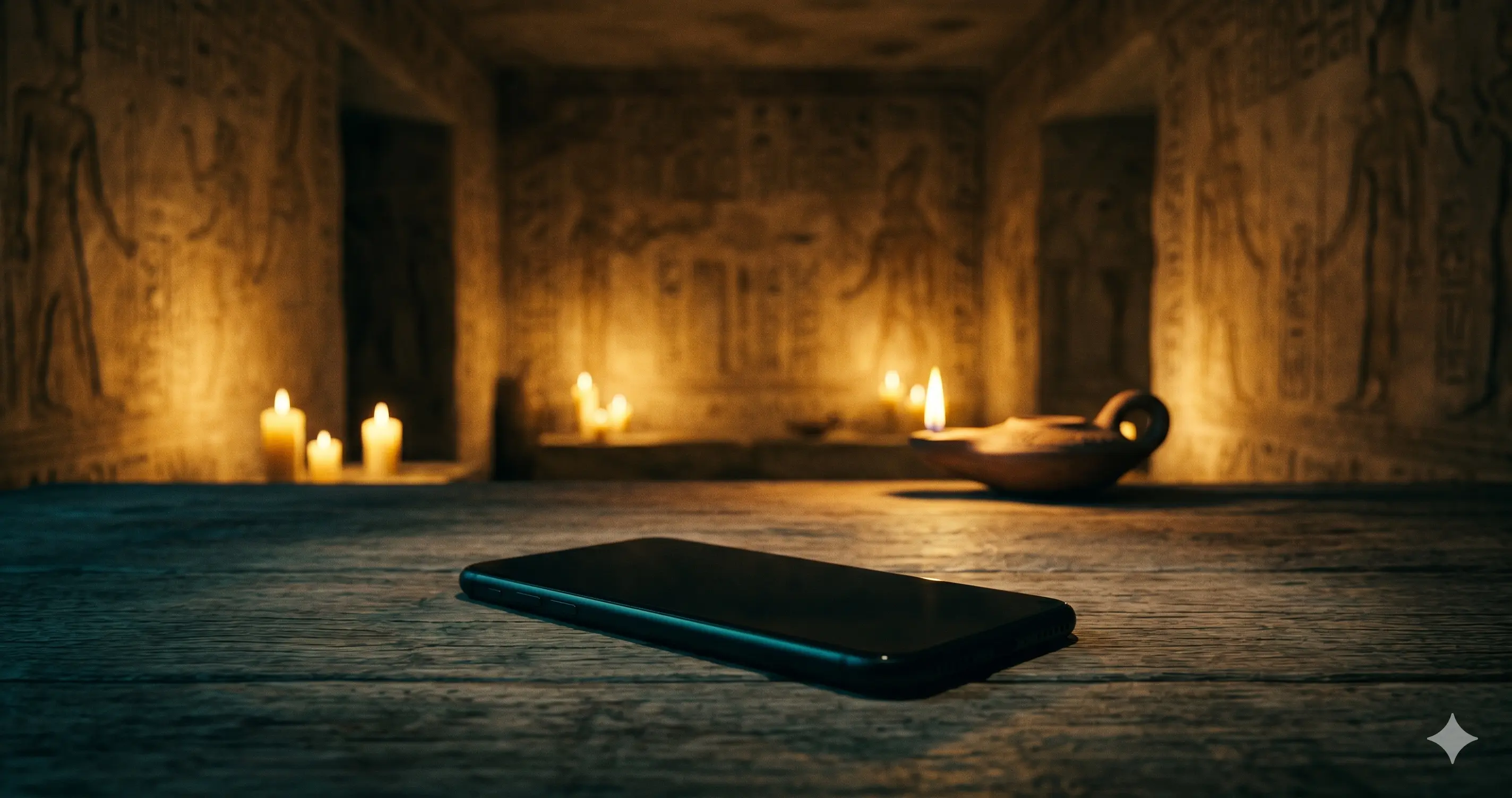
A Digital Detox in 90 Minutes: One Format That Actually Works
When was the last time you went 90 minutes without looking at your phone? Not "didn't use it" — actually didn't see it? One format in Prague where it happens by itself.
Try to remember: when was the last time you went 90 minutes without looking at your phone? Not "I put it on the table", but literally — didn't pull it out, didn't check, didn't react to notifications?
If "while sleeping" comes to mind, that's your answer. Most people in 2026 have lost the ability to be offline during waking hours. The average adult unlocks their phone 50–80 times a day. That means every 12–15 minutes you interrupt whatever you were doing.
And the sneakiest part — even "rest" usually happens with a phone in hand. Coffee with friends? Within five minutes all three phones are on the table. A series? Scrolling on the side. A walk in the park? Podcast in your ears and stories in the breaks.
This article is about a rare format in which a digital detox happens by itself, without effort, without willpower, and without "today I'll try not to open Instagram".
Why the usual detox doesn't work
Books and blogs about digital detox typically advise:
- Put the phone in another room.
- Block apps for the day.
- Switch to "greyscale mode".
- Go somewhere with no signal.
All of this works poorly or doesn't work at all. The reason is simple — you're left alone with yourself. No task, no structure, no external stimulus. A brain used to 80 unlocks a day starts demanding its dose within 30 minutes. And you either give in or suffer.
An effective detox works the opposite way: give your brain another task, one so absorbing that you forget about the phone yourself. Don't subtract the stimulus — replace it.
Sport works. Dance works. A focused hobby (painting, cooking, craft) works. And one more format that gets written about less — puzzles under time and team pressure.
What an escape room gives you, detox-wise
When you walk into an escape room, your phone, wallet, watch, and bag go into a locker. Not "please leave them here", but physically not with you any more. The door closes, and you won't see them until the game ends.
That's a rare situation in 2026. In a cinema you can sneak a glance. At a restaurant you'll definitely check. On a date you'll probably look. Even on a plane in airplane mode you keep the device in your hand.
In an escape room — no. And that's the whole point.
The second mechanism kicks in next. A team of 2–5 people finds itself inside a single task that has to be solved in 90 minutes. The brain switches into what psychologists call flow — a state of complete absorption in a task, where the sense of time disappears and anxious thoughts drop out. Mihaly Csikszentmihalyi described the phenomenon back in the 1990s: flow requires three conditions — a clear goal, immediate feedback, a balance of difficulty and skill.
An escape room delivers all three. The goal — get out in 90 minutes. Feedback — the lock opened or didn't. Difficulty — calibrated by the operator (if the group gets stuck, a hint comes through the game channel).
After 90 minutes, people walk out with that "soft-focus" gaze you usually get after a good workout or deep sleep. That's the detox.
What players notice after the game
Players for whom the detox was an important part of the experience (rather than a side effect) describe similar things:
- Calm. A sense that things have "quietened down" inside. The usual anxious background hum is a few hours softer.
- Sharp focus. After an hour of locked-in attention on one task, your ability to concentrate returns — even on boring tasks afterwards.
- Reluctance to grab the phone. After the game the group usually goes to dinner, and many notice: you don't want to pull out the phone for another couple of hours. The habit weakens temporarily but noticeably.
- Full presence in conversation. At the dinner after an escape room, people listen to each other. Everyone has a fresh shared memory; there's something real to talk about.
The effect isn't permanent — within a day the brain returns to its usual rhythm. But in the moment, it works.
Who it especially helps
Freelancers and remote workers, for whom the line between work and rest has dissolved. If your phone is at once work, entertainment, and contact with loved ones, then "a break from your phone" equals a break from everything at once. An escape room creates that line from the outside.
Parents of small children, for whom the phone has become the main channel of communication and anxiety (nursery, parent chats, nanny). 90 minutes guaranteed without a phone — a rare luxury.
People under heavy load or burnout. It doesn't cure, but it gives a reset point. Doing it once a month produces more noticeable effect than a spa visit.
Couples whose evenings have become parallel scrolling. More couples know this than admit it openly. An escape room is a format where you actually talk again, instead of lying side by side in your phones.
What if I don't like escape rooms?
Then look for another format with the same three conditions: a clear goal, feedback, a balance of difficulty. Dance class works. Life drawing works. Pottery, climbing, a long board-game session with friends — all work.
The key — the phone has to physically be elsewhere. If the device stays in your pocket, the brain knows the dose is within reach, and half the effect is lost.
Our Pharaoh's Tomb as a detox format
Specifically, with us:
- Phones and bags are stored in a locker before the game.
- 90 minutes inside (with the briefing and final photo, around 100 minutes of total time).
- Atmosphere — no actors, no jumpscares. Soft adventurous mood, not horror.
- Difficulty 4/5 — it genuinely engages the brain, without the depressing "we solved nothing".
- 97–98% of groups finish. If you get stuck, our operators step in through the game channel and gently nudge you.
If you come with company, the sweet spot is 3–4 people. Longer than a film, cheaper than a spa, more effective than "tonight I'll try not to open Instagram".
→ Book Pharaoh's Tomb — pick a weekday evening for maximum effect (after work — point of reset).
90 minutes without a phone — probably the best thing you'll give your nervous system this week.
