7 Mysterious Facts About Tutankhamun's Tomb That Might Surprise You
From the pharaoh's curse to hidden chambers — stories and facts that inspired our Pharaoh's Tomb escape room in Prague.
When Howard Carter uncovered a sealed doorway in the Valley of the Kings on November 4th, 1922, nobody suspected what lay behind it: the most intact pharaoh's tomb archaeology has ever known. Our Pharaoh's Tomb escape room is a tribute to that story — and here are seven facts that inspired it.
1. The tomb was practically untouched
Most tombs in the Valley of the Kings were looted back in antiquity. Tutankhamun's tomb (KV62) survived because debris from the construction of another tomb above it buried its entrance — and later thieves never stumbled upon it. Carter found more than 5,000 artifacts untouched for over 3,000 years.
2. "The curse of the pharaohs" — a myth that still lives
In the years after the tomb was opened, several members of the expedition died. Lord Carnarvon, who funded the dig, died of blood poisoning from a mosquito bite just four months after entering the tomb. Journalists instantly named it "the curse of the pharaohs." Statistics don't really back it up — most of the expedition lived on for decades — but the legend endures and has inspired films and escape rooms ever since.
3. The golden death mask weighs 11 kilograms
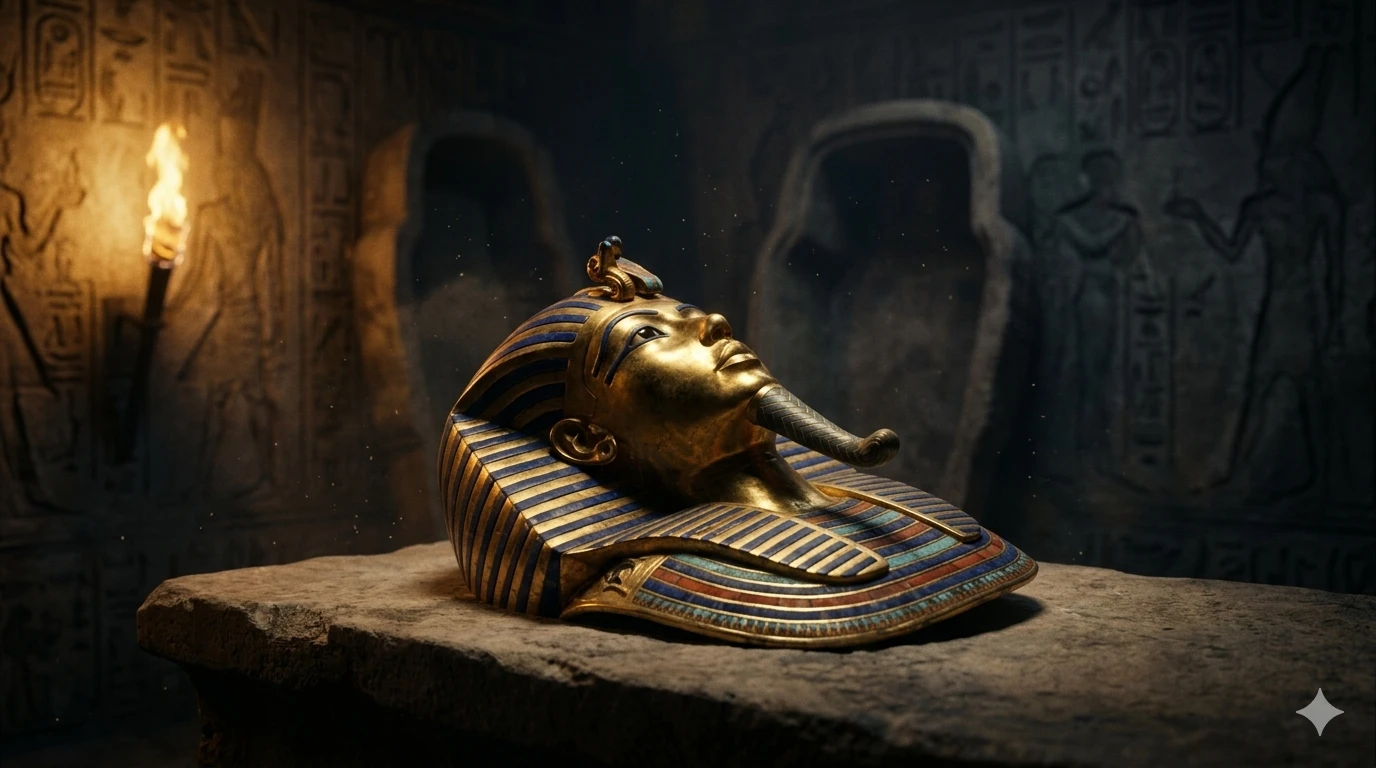
The most famous artifact in Egyptian archaeology is made of solid gold (22 karat), lapis lazuli, carnelian, and turquoise. Its exact weight — 11.25 kg — and the fineness of its craftsmanship are still breathtaking today. The original is displayed at the Grand Egyptian Museum in Cairo.
4. A dagger made of meteoric iron
One of the most fascinating finds is a dagger whose blade was made from iron coming from a meteorite. A 2016 analysis confirmed the material came from outer space. The ancient Egyptians viewed meteoric iron as "metal from the heavens" — and it was more valuable than gold.
5. Tutankhamun died very young
The pharaoh was only about 19 years old when he died. Modern DNA analysis and CT scans suggest he suffered from malaria, a broken leg, and several genetic issues (likely the result of dynastic marriages between siblings). His death remains debated to this day — accident, illness, or murder?
6. The hidden chamber theory
In 2015, British Egyptologist Nicholas Reeves published a theory that behind the north wall of the burial chamber lies another, undiscovered chamber — possibly the tomb of Queen Nefertiti. Radar scans have given contradictory results so far. The question remains open, and many experts believe the tomb hasn't yet revealed all its secrets.
7. Modern discoveries with modern tech
In recent years the mummy and artifacts have been studied with methods nobody could have imagined in 1922 — CT scanning, genetic analysis, spectrometry. Thanks to these, we now know the mask was originally made for someone else (likely Nefertiti), and only later adapted for Tutankhamun.
Feel the atmosphere yourself
In our Pharaoh's Tomb escape room we tried to bring that unmistakable atmosphere of ancient Egypt to Prague. You won't be excavating a real grave, but you will be unraveling puzzles rooted in Egyptian mythology, hieroglyphs, and burial rituals. 90 minutes, 2–5 players, difficulty 4/5.
If the topic pulled you in, have a look at our escape room in Prague right in the city center.
Carter spent ten years inside the tomb — you have 90 minutes. Can you handle it?
